Asian Brown Wood Owl
In the warm, shadowed forests of South and Southeast Asia—where ancient trees rise above tangled undergrowth and the air carries the constant hum of insects—the Asian Brown Wood Owl reigns as a quiet sovereign of the night. Scientifically known as Strix leptogrammica, this imposing owl is a creature of dusk and darkness, its deep, resonant calls echoing through valleys and jungle corridors like a distant drumbeat. Unlike the ghostly white hunters of the Arctic or the sunlit hawks of the savanna, the Asian Brown Wood Owl belongs to a world of filtered moonlight and dense canopy, where patience, silence, and acute senses define survival. Elusive and often heard more than seen, it embodies the mystique of Asia’s forests—a powerful yet understated predator whose presence hints at the richness and depth of its habitat.
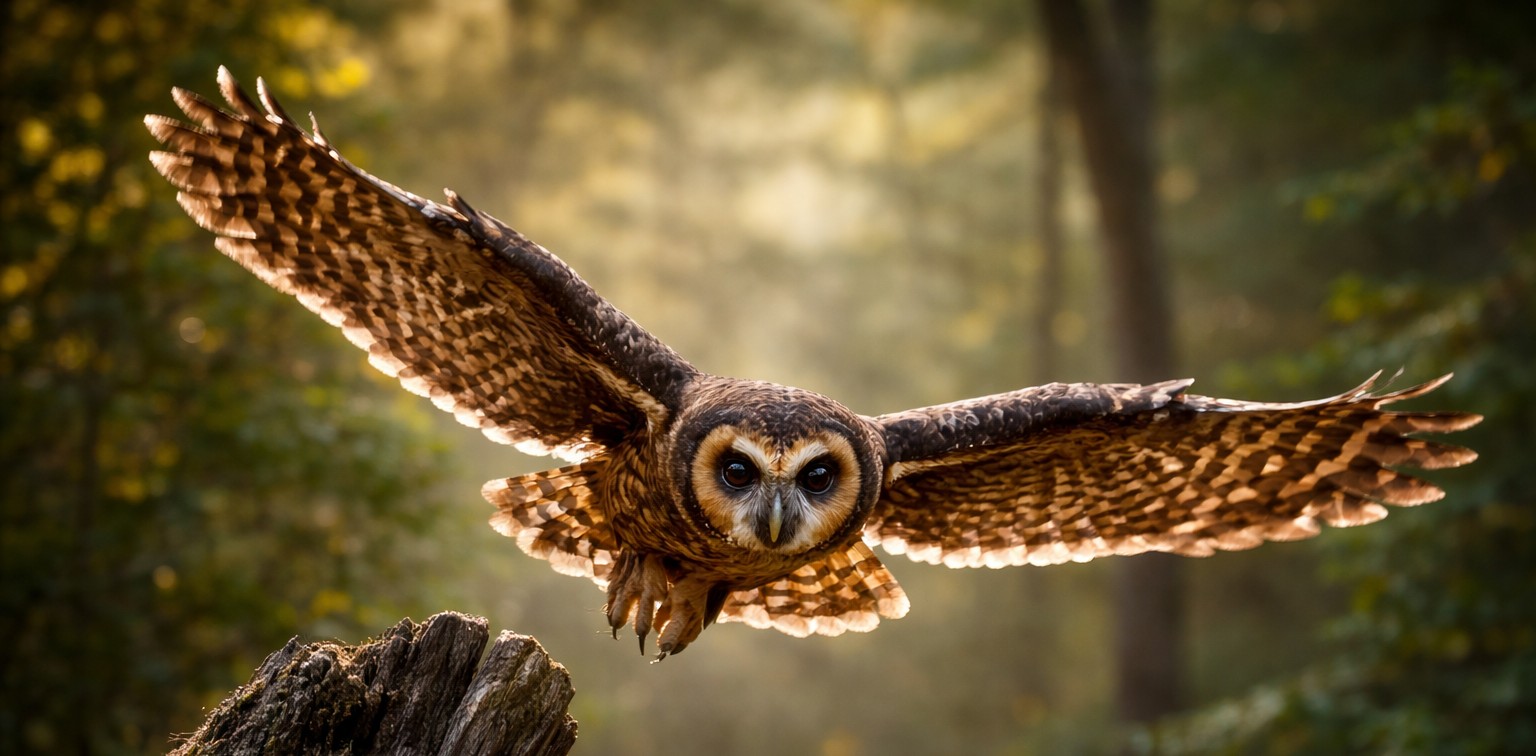
Physically, the Asian Brown Wood Owl is a large and commanding member of the Strix genus, built for stealth and endurance rather than speed. Measuring between 45 to 57 centimeters in length, with a wingspan approaching 110 to 130 centimeters, it is among the larger wood owls of its range. Its plumage is a beautifully intricate blend of warm browns, buff tones, and darker streaks, creating a bark-like pattern that renders it nearly invisible against tree trunks during the day. The rounded head, lacking ear tufts, is framed by a prominent facial disc that channels sound toward its asymmetrically placed ears—an adaptation that allows for pinpoint accuracy when locating prey in complete darkness. Its large, dark brown to almost black eyes are adapted for low-light vision, giving it a deep, soulful expression that reflects its nocturnal nature. Strong, feathered legs and formidable talons provide the tools necessary to capture and subdue a wide range of prey, while its broad wings are designed for silent flight, the feather edges softened to muffle sound as it glides through the forest.
Habitat-wise, the Asian Brown Wood Owl is closely tied to mature forests, thriving in a variety of wooded environments including tropical rainforests, subtropical woodlands, and even well-vegetated plantations. Its range spans a vast area from the Indian subcontinent through Sri Lanka, Nepal, and Bhutan, extending eastward into Southeast Asia, including Thailand, Malaysia, Indonesia, and parts of southern China. Despite this wide distribution, it is highly dependent on tree cover, particularly large, old trees that provide suitable roosting and nesting sites. During daylight hours, it remains concealed within dense foliage, relying on its camouflage to avoid detection. At dusk, it becomes active, emerging silently to patrol its territory. Nesting typically occurs in natural tree cavities or abandoned nests of other large birds, with breeding seasons varying regionally but often coinciding with periods of increased prey availability. Females usually lay one to two eggs, investing significant care into raising a small number of well-developed offspring.
Behaviorally, the Asian Brown Wood Owl is the embodiment of nocturnal precision and calm authority. It is primarily solitary or found in pairs, maintaining territories that are defined more by sound than sight. Its vocalizations are among its most distinctive features—a series of deep, rhythmic hoots that can carry over long distances, often exchanged between mates in haunting duets that reinforce pair bonds and territorial boundaries. These calls, sometimes described as a soft but persistent “who-who-who,” lend an almost meditative quality to the forest night. Unlike more active or restless species, this owl often employs a sit-and-wait hunting strategy, remaining perched for extended periods before launching a silent glide toward its target. Its movements are deliberate and economical, conserving energy while maximizing efficiency. Despite its calm demeanor, it is a capable and assertive predator when necessary, particularly during breeding season when it defends its territory and young with quiet determination.
Hunting reveals the owl’s true mastery of darkness, combining acute hearing with near-silent flight to devastating effect. Its diet is varied and opportunistic, including small mammals such as rodents, bats, and shrews, as well as birds, reptiles, amphibians, and large insects. The facial disc plays a crucial role, funneling even the faintest rustle of movement toward its ears, allowing it to detect prey hidden beneath leaves or vegetation. Once a target is located, the owl descends in a controlled glide, striking with precision and force. Its talons grip firmly, ensuring prey has little chance of escape. Like other owls, it regurgitates pellets containing bones, fur, and other indigestible material, providing valuable data for researchers studying its feeding habits and local biodiversity. Its role as a nocturnal predator makes it an essential regulator of small animal populations within its ecosystem.
Within falconry and wildlife education, the Asian Brown Wood Owl occupies a more specialized and less conventional role. Owls, in general, are not traditional falconry birds due to their independent nature and different hunting styles, and this species is no exception. However, it is sometimes featured in educational programs and wildlife centers, where its calm presence and impressive size make it a compelling ambassador for forest conservation. Training typically focuses on short, controlled flights to a handler’s glove, often using food rewards to encourage participation. Unlike diurnal raptors, it does not thrive on repetitive training routines and instead requires a patient, respectful approach that acknowledges its natural instincts. In these settings, it serves to educate audiences about the importance of forest ecosystems, nocturnal wildlife, and the delicate balance required to sustain biodiversity.
The conservation outlook for the Asian Brown Wood Owl is currently considered relatively stable, though it is increasingly affected by habitat loss and fragmentation across its range. As forests are cleared for agriculture, logging, and urban expansion, the availability of suitable nesting sites and hunting grounds diminishes. While the species shows some adaptability—occasionally inhabiting plantations or secondary growth—it remains dependent on the presence of mature trees and a healthy understory. In certain regions, local populations may be declining, highlighting the need for continued monitoring and habitat protection. Conservation efforts aimed at preserving forest ecosystems benefit not only this owl but countless other species that share its environment. Raising awareness through education and ecotourism also plays a role in ensuring its long-term survival.
Anecdotes surrounding the Asian Brown Wood Owl often emphasize its mysterious and almost spiritual presence. In many rural areas, its calls are woven into local folklore, sometimes seen as omens or messages from the unseen world, reflecting humanity’s long-standing fascination with nocturnal birds. Observers who are fortunate enough to encounter one in the wild often describe a profound stillness—a moment where the forest seems to pause as the owl watches silently from its perch. In captivity, individuals may display subtle curiosity, tracking movement with slow, deliberate head turns, yet always retaining a sense of distance that speaks to their wild origins. Their longevity is notable, with lifespans reaching over 20 years in the wild and longer under human care, each year adding to their quiet mastery of the night.
As we consider the Asian Brown Wood Owl, we are reminded of the hidden rhythms that govern the natural world after sunset. It is a guardian of the forest’s darker hours, a predator shaped by shadow and silence, perfectly attuned to its environment. In wildlife centers and educational programs, where its broad wings cut softly through dim light, it offers a rare glimpse into the nocturnal realm—a reminder that even in darkness, life thrives with complexity and grace. Protecting the habitats it depends on ensures that its deep, echoing calls will continue to resonate through Asia’s forests, carrying with them the enduring spirit of the wild.