Gabar Goshawk
In the sun-drenched savannas and thornveld of sub-Saharan Africa, where acacia trees cast dappled shadows over dry earth and the air hums with life, the Gabar Goshawk moves like a whisper through the branches—a compact, fierce raptor whose subtle presence belies its deadly precision. Scientifically named Micronisus gabar, this small but formidable hawk is a master of ambush, threading effortlessly through dense vegetation in pursuit of unsuspecting prey. Unlike the towering eagles of open skies, the Gabar Goshawk belongs to a more secretive world, one of quick bursts, sharp turns, and calculated strikes. Often overlooked due to its size, it is nonetheless one of Africa’s most efficient aerial hunters, embodying agility, adaptability, and quiet intensity in equal measure.
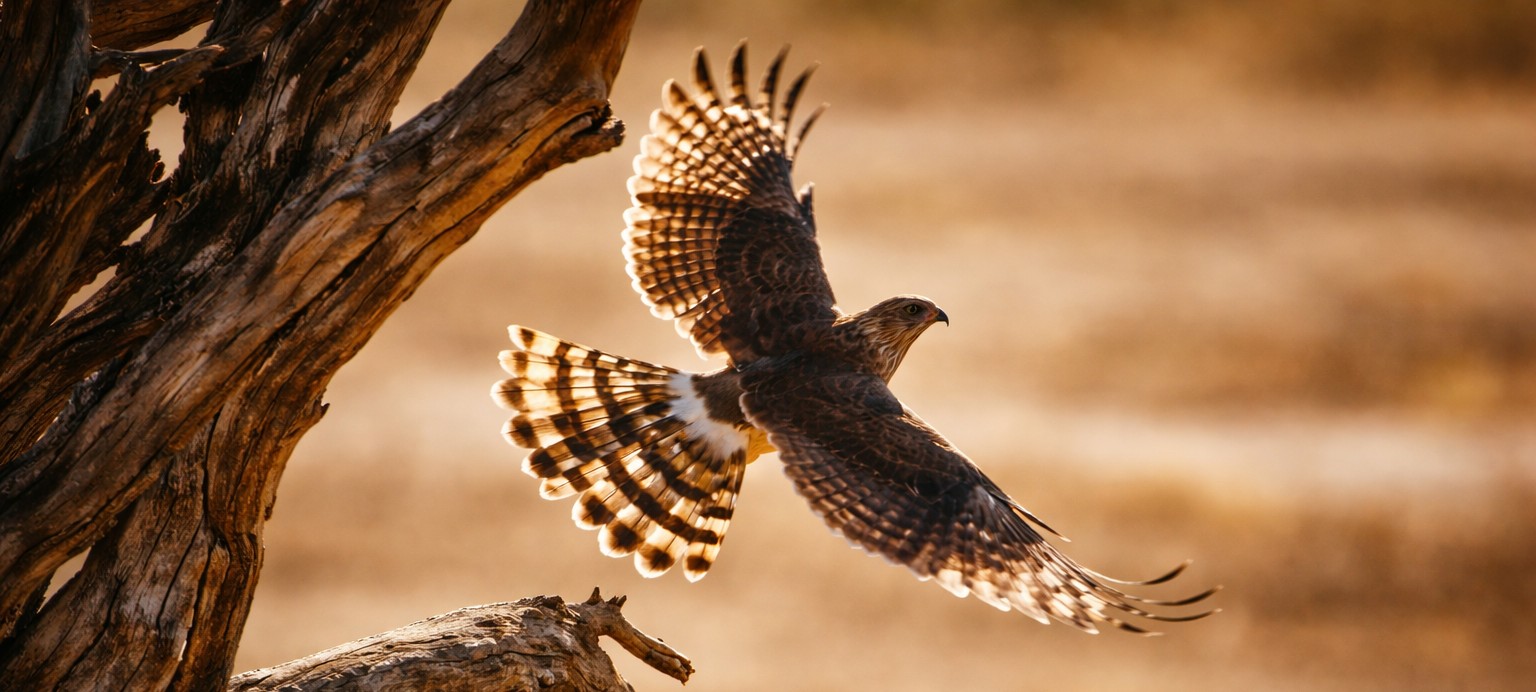
Physically, the Gabar Goshawk is a study in compact power and aerodynamic finesse. Measuring between 28 to 36 centimeters in length, with a wingspan of around 60 to 75 centimeters, it is relatively small for a goshawk, yet perfectly built for maneuverability rather than brute strength. Its long tail acts as a rudder, allowing rapid directional changes mid-flight, while its short, rounded wings enable explosive acceleration through tight spaces. Plumage varies between two distinct color morphs: the more common grey morph, with soft slate-grey upperparts and finely barred underparts, and the striking dark morph, almost entirely black with subtle barring—an adaptation that may offer advantages in certain lighting conditions. Bright red or deep orange eyes stand out vividly against its face, giving it an intense, almost fiery expression. Its legs and cere are typically orange-yellow, equipped with sharp talons designed for gripping small, fast-moving prey. Sexual dimorphism is present but subtle, with females slightly larger than males, a common trait among birds of prey.
Habitat-wise, the Gabar Goshawk thrives across a wide range of African landscapes, from open savannas and woodland edges to semi-desert scrub and even suburban gardens. Its range stretches across much of sub-Saharan Africa, from Senegal and Ethiopia in the north down to South Africa, adapting readily to local conditions as long as there is sufficient cover for hunting. Unlike many raptors that avoid human presence, the Gabar Goshawk has shown remarkable tolerance for modified environments, often nesting in urban parks, farms, and villages where prey such as small birds and rodents are abundant. Nests are typically built high in trees, constructed from sticks and lined with softer materials, providing a secure platform for raising young. Breeding seasons vary by region but generally align with periods of increased prey availability. Females lay two to four eggs, which are incubated primarily by the female while the male provides food. Chicks hatch after about 33 to 35 days and grow rapidly, fledging within a month yet remaining dependent on their parents for several weeks as they refine their hunting skills.
Behaviorally, the Gabar Goshawk is an embodiment of stealth and efficiency, rarely drawing attention to itself unless in motion. It spends much of its time perched quietly within foliage, scanning for movement with unwavering focus. When an opportunity arises, it launches into a rapid, low-level pursuit, weaving through branches with astonishing agility. This species is known for its boldness; despite its size, it will readily take on prey nearly its own weight and defend its territory with surprising aggression. Vocalizations are sharp and repetitive, often heard during breeding season as a series of high-pitched calls that echo through woodland areas. Outside of breeding, individuals are typically solitary, maintaining well-defined territories. Intelligence is evident in their hunting strategies; Gabar Goshawks have been observed using cover effectively, approaching prey from concealed angles and even exploiting human-altered environments to their advantage.
Hunting is where the Gabar Goshawk truly excels, showcasing a blend of speed, precision, and adaptability. Its diet is diverse, consisting primarily of small birds such as finches, doves, and sparrows, but also including rodents, reptiles, and large insects. Unlike soaring raptors, it relies on surprise rather than endurance, launching sudden attacks from concealed perches or engaging in short, high-speed chases through dense vegetation. Its flight is rapid and direct, punctuated by quick wingbeats and glides, allowing it to close distances in seconds. The long tail provides exceptional control, enabling it to twist and turn mid-air to match the evasive maneuvers of its prey. Once captured, prey is subdued with sharp talons and dispatched quickly. Like other raptors, it produces pellets composed of indigestible material, offering insights into its diet and local ecosystem dynamics.
In the context of falconry, the Gabar Goshawk occupies a more specialized and less traditional role. While not as widely used as larger hawks or falcons, it has attracted interest among experienced falconers who appreciate its agility and spirited nature. Training a Gabar Goshawk requires patience and finesse; it is an intelligent but independent bird that does not respond well to heavy-handed methods. When properly trained, it can be flown at small game or used in demonstration flights, showcasing its remarkable speed and maneuverability. However, its relatively small size and high-strung temperament mean it is better suited to skilled handlers rather than beginners. In educational settings, it serves as an excellent ambassador for African raptor diversity, highlighting the importance of smaller predatory birds within ecosystems.
The conservation status of the Gabar Goshawk is currently considered stable, classified as a species of least concern due to its wide distribution and adaptability. However, like many raptors, it faces localized threats from habitat degradation, pesticide use, and human disturbance. Its willingness to inhabit human-altered landscapes has helped buffer it against more severe declines, yet this proximity also exposes it to risks such as collisions and secondary poisoning. Ongoing monitoring and habitat conservation efforts are essential to ensure populations remain healthy, particularly in regions undergoing rapid environmental change. The species also plays a vital ecological role, helping to control populations of small birds and rodents, thereby maintaining balance within its habitats.
Anecdotes surrounding the Gabar Goshawk reveal a bird full of character and surprising behaviors. In some regions, individuals have been observed nesting close to human dwellings, seemingly unbothered by daily activity, while taking advantage of abundant prey attracted to gardens and farms. One particularly fascinating behavior involves their association with certain insects; Gabar Goshawks have been known to incorporate pieces of fresh foliage into their nests that release chemical compounds capable of repelling parasites—a natural form of pest control that demonstrates an impressive level of environmental awareness. Their presence often goes unnoticed until a sudden flash of movement betrays their hunt, a fleeting glimpse that leaves observers struck by their speed and precision.
As we turn our attention to the Gabar Goshawk, it becomes clear that greatness in the raptor world is not defined solely by size or spectacle, but by mastery of environment and purpose. This small African hunter, moving silently through sunlit thickets and shadowed branches, represents a different kind of power—one rooted in agility, intelligence, and quiet determination. Whether glimpsed darting through woodland or perched watchfully in the still heat of the savanna, the Gabar Goshawk reminds us that even the most unassuming predators play a vital role in the intricate tapestry of life, deserving both admiration and protection for generations to come.