Snowy owl
In the silent, wind-swept expanses of the Arctic tundra—where the horizon blurs into endless white and the sun lingers low for months—the Snowy Owl emerges as a ghost of the north, a radiant predator cloaked in winter itself. Scientifically known as Bubo scandiacus, this striking bird of prey is one of the most iconic inhabitants of the polar world, its plumage a living camouflage against snow and ice. Unlike the shadowy silhouettes of forest owls, the Snowy Owl is a creature of open light, often active by day, its pale form gliding low over frozen ground like a drifting spirit. Revered in cultures from the Inuit of North America to Norse traditions, where it symbolized wisdom and watchfulness, the Snowy Owl carries an aura of quiet power—a sentinel of the far north whose presence feels both ancient and otherworldly.
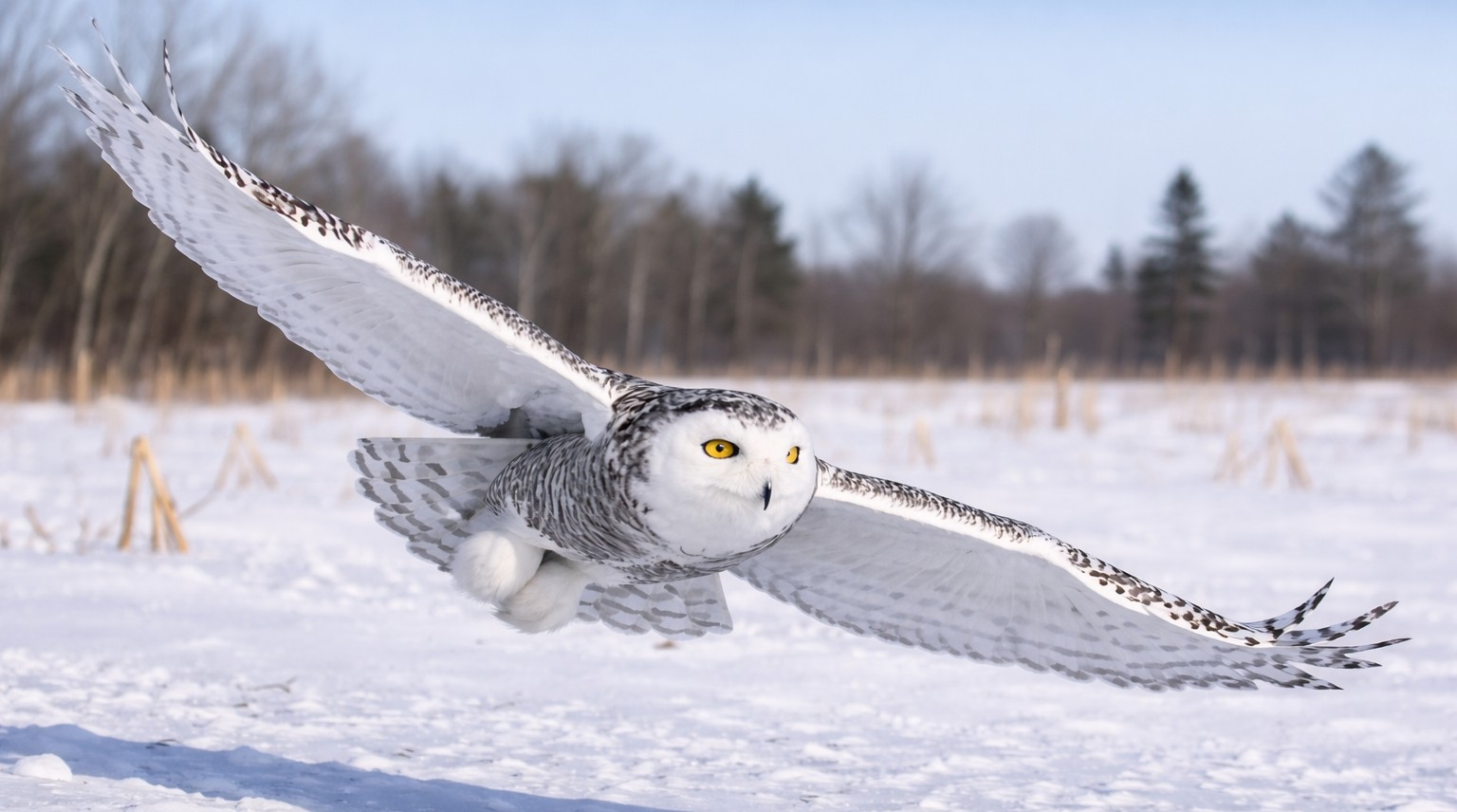
Physically, the Snowy Owl is a masterpiece of Arctic adaptation, built for endurance in one of the harshest climates on Earth. Measuring between 20 to 28 inches in length, with a wingspan reaching up to 5 feet, it is among the largest owl species in the world. Females are noticeably larger and more heavily marked with dark barring, while mature males can appear almost pure white, their minimal markings giving them an ethereal, almost luminous appearance against snowy landscapes. This sexual dimorphism serves both camouflage and breeding roles, with females blending into nesting grounds while males stand out in territorial displays. Thick feathering covers nearly every inch of their bodies—including their legs and toes—providing insulation against subzero temperatures that can plunge below -50°C. Their eyes, a vivid golden yellow, are adapted for keen long-distance vision rather than the extreme night sensitivity of woodland owls, reflecting their diurnal tendencies. Unlike many owls, Snowy Owls lack prominent ear tufts, giving their rounded heads a smooth, almost sculpted look, while their powerful black beaks are often partially hidden beneath a mask of dense facial feathers.
Habitat-wise, the Snowy Owl is intrinsically tied to the Arctic tundra, breeding across northern regions of Canada, Alaska, Greenland, Scandinavia, and Russia. These vast, treeless plains offer unobstructed views essential for spotting prey, as well as elevated perches like rocks or small rises. Unlike many raptors, Snowy Owls are nomadic and highly responsive to food availability, particularly populations of lemmings—their primary prey. In years of abundance, they remain in high Arctic breeding grounds, but during “irruption” years, when prey declines, they journey south in dramatic movements that can bring them into southern Canada, the northern United States, and occasionally as far as the UK and mainland Europe. Coastal dunes, airports, farmland, and open moorland can temporarily host these Arctic wanderers, where their presence often draws crowds of birdwatchers eager for a glimpse. Nesting occurs directly on the ground, where the female scrapes a shallow depression in a slightly elevated area, offering visibility and protection from flooding. Clutch sizes vary dramatically depending on food supply, ranging from 3 to an astonishing 11 eggs in peak lemming years, with incubation lasting about 32 days.
Behaviorally, the Snowy Owl is a study in quiet efficiency and calculated patience. Often seen perched motionless for hours, it surveys the landscape with unwavering focus, conserving energy in an environment where every calorie counts. When prey is detected, it launches into a low, buoyant flight, wings beating slowly and silently before dropping with precise accuracy. Unlike many owl species that rely heavily on nocturnal hunting, Snowy Owls are primarily active during daylight hours in the Arctic summer, taking advantage of the continuous sunlight. They are fiercely territorial during breeding season, with males defending vast areas through aerial displays and vocalizations—a series of deep, booming hoots that carry across the tundra. Outside of breeding, they become more solitary, though in prey-rich wintering grounds, multiple individuals may be seen hunting within relatively close proximity. Intelligence and adaptability define their survival; Snowy Owls have been observed altering hunting strategies based on terrain, weather, and prey behavior, and they possess remarkable spatial awareness, often returning to successful hunting grounds across seasons.
Hunting reveals the Snowy Owl’s lethal precision, a balance of stealth, speed, and raw power. Lemmings and voles form the backbone of their diet, sometimes comprising over 90 percent of their intake during breeding season. A single owl may consume several thousand rodents in a year, playing a crucial role in regulating tundra ecosystems. Yet, they are far from specialists; birds such as ptarmigan, ducks, and even seabirds fall prey to their talons, while in lean times they may take rabbits or scavenge carrion. Their hearing, though less specialized than forest owls, is still finely tuned, capable of detecting movement beneath snow, while their vision allows them to track motion across vast distances. When striking, they extend powerful talons that can exert crushing force, dispatching prey instantly. Like other owls, they regurgitate pellets composed of bones and fur, leaving behind evidence of their meals that researchers use to study diet and ecosystem health.
Within falconry and wildlife education, the Snowy Owl holds a unique and captivating role. While not traditionally favored in classical falconry due to their independent nature and sensitivity, they are highly valued in educational programs and demonstrations across Europe and North America. Their calm demeanor and striking appearance make them exceptional ambassadors for Arctic conservation. In controlled environments, Snowy Owls can be trained to fly short distances to the falconer’s glove, often using food rewards such as chicks or rodents, though training requires patience and a deep understanding of their temperament. Unlike hawks or falcons, they do not thrive on repetitive drills and instead respond best to trust-based handling. Wildlife centers often highlight their ecological importance, using them to educate the public about climate change and fragile Arctic ecosystems. Legal protections vary by region, but most captive individuals are bred in controlled programs or rehabilitated from the wild, ensuring ethical standards are maintained.
The story of the Snowy Owl is deeply intertwined with environmental change, a symbol of both resilience and vulnerability. While currently classified as vulnerable in some regions due to declining populations, their numbers fluctuate naturally with prey cycles, making long-term trends complex to assess. Climate change poses a growing threat, altering tundra habitats and disrupting the delicate balance of lemming populations. Additionally, increased human activity in Arctic regions, collisions with vehicles and aircraft—especially during southern irruptions—and habitat encroachment all contribute to ongoing pressures. Conservation efforts focus on habitat protection, research into migration patterns through satellite tracking, and public education campaigns. Organizations across the globe monitor populations and nesting success, while citizen science initiatives encourage reporting of sightings during irruption years, helping scientists map their movements with unprecedented detail.
Anecdotes from the world of the Snowy Owl capture both its mystique and adaptability. In the Arctic, they have been observed standing resolute through blizzards, snow accumulating on their backs as they wait patiently for movement beneath the surface. During irruption events, individuals have appeared in unexpected places—perched on airport runways, drifting across coastal dunes, or even resting atop urban buildings, momentary visitors from another world. Some have been tracked traveling thousands of miles across continents, navigating vast and featureless landscapes with uncanny precision. In captivity, their personalities emerge subtly; some individuals show curiosity toward human activity, tilting their heads in silent observation, while others remain distant and inscrutable, embodying the wild even within enclosures.
As we behold the Snowy Owl—whether in the boundless Arctic or as a fleeting winter visitor farther south—it stands as a living embodiment of the north’s stark beauty and fragile balance. Its silent wings carry stories of survival written in ice and wind, a reminder that even in the harshest corners of the Earth, life not only endures but thrives with quiet brilliance. In falconry fields and wildlife centers, where its pale form cuts across the sky in controlled flight, the Snowy Owl invites us to look northward with respect and responsibility, to protect the frozen realms it calls home, and to ensure that its ghostly presence continues to haunt the tundra for generations to come.